


You just finished a strong sales call. The client is interested, the fit is clear and the next move is simple. Send a proposal while the conversation is still fresh. Then real life gets in the way.
Writing that proposal takes an hour or three. You have to write up your notes, dig out the current pricing, find a case study that matches the client, shape it all into your company template, match the brand voice and make sure you have not promised anything you should not. Meanwhile the next call is starting. So the proposal slips to tomorrow, then to the day after and the warm lead cools. In sales, speed is not a nice extra. It often decides who wins.
This article walks through a simple system that removes most of that delay. An AI agent listens to the call, drafts the proposal, checks it against your brand and your rules and passes it to a person for a final look. The goal is not to replace the salesperson. The goal is to hand them a solid first draft minutes after the call, so their time goes into the client and not into assembly.
The problem: Why proposals are a bottleneck
A proposal feels like it should be quick. You already had the conversation, so surely writing it up is a formality. In practice it is a small project every single time. The pricing lives in one place, the case studies in another, the template in a third and the brand rules in someone's head. Pulling all of that together is slow, repetitive work and it is the kind of work that always loses to the next live conversation.
So proposals wait. A day here, three days there. Each day of delay lets a competitor get there first or lets the client's attention drift to the next thing. The irony is that none of the slow part is the valuable part. The value was the call. The assembly afterwards is exactly the sort of task a machine should carry.
The blueprint: The idea in one picture
The whole system is six simple steps. The agent does the heavy lifting in the middle and a person stays in control at the end. Here is the shape of it.
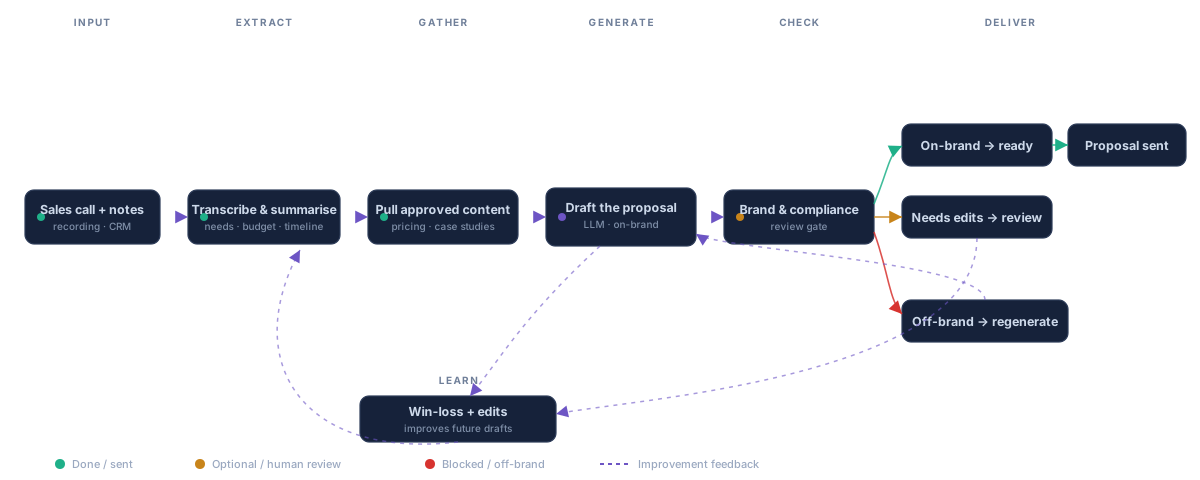
Six steps: take in the call, pull out what matters, gather approved content, draft, check and deliver. A person sends it and every result feeds back to improve the next draft.
The one idea to hold onto is simple. The machine writes and the person approves. That split is what makes it safe to use on something as important as a client proposal.
Step 1: Listen and summarise
The system starts with the raw material you already have: the call recording and whatever notes landed in your CRM. First it turns the audio into text. Then it reads that text and pulls out the handful of things a proposal actually needs. Who the client is, what they want, the budget they hinted at, the timeline and any worries they raised.
What is speech-to-text? Speech-to-text is software that listens to audio and writes down the words. Modern versions are accurate enough to handle a normal sales call, accents and cross-talk included. Once the call is text, a language model can read it and answer plain questions about it, the same way a person could if they had the time to sit and read the transcript.
In code the step is short. You transcribe the recording, then ask a language model to return the summary as a few tidy fields.
# Turn the call recording into a short, structured summary
transcript = speech_to_text(call_recording)        # audio to text

summary = llm(
    "Read this sales call transcript and pull out, in plain fields: "
    "the client, their main need, budget, timeline and any objections."
    + transcript
)
# summary -> { client, need, budget, timeline, objections }
Step 2: Pull the approved content
This step is where trust is won or lost. A proposal must never contain a made-up price or an invented customer story. So the agent is not allowed to write those from memory. It looks them up from a library you control: your current price list and the real case studies you have approved for use. It picks the ones that fit this client, for example a story from the same industry.
Why approved content matters Language models are good at sounding confident, which is a problem when the facts have to be exact. The fix is to keep the facts out of the model's imagination and in a trusted store. The model is allowed to phrase things nicely. It is not allowed to decide what the price is. That separation is what keeps the draft accurate.
# Only ever use approved, current content. Never invent a price or a story.
pricing = pricing_book.lookup(product=summary["need"])            # current price list
cases   = case_studies.search(industry=summary["industry"], top_k=2)  # real, approved

approved_context = { "pricing": pricing, "case_studies": cases }
Step 3: Draft the proposal
Now the agent has everything it needs: a clean summary of the call and a set of approved facts to build on. It hands both to a language model, along with your brand voice guide and your proposal template and asks for a first draft. The model does what it is genuinely good at, which is turning structured input into clear, well-organised writing.
# Write the draft from the summary and approved content, in your brand voice
draft = llm(
    system = brand_voice_guide,          # tone, style, rules to follow
    prompt = proposal_template.format(
        summary = summary,
        pricing = approved_context["pricing"],
        cases   = approved_context["case_studies"],
    )
)
Keep the facts pinned. Let the model choose the words but do not let it choose the numbers. Prices, dates and client details are dropped in exactly as they came from the approved content and the call summary. The model writes around them. This is the difference between a draft you can trust and one you have to fact-check line by line.
Step 4: Check brand and rules
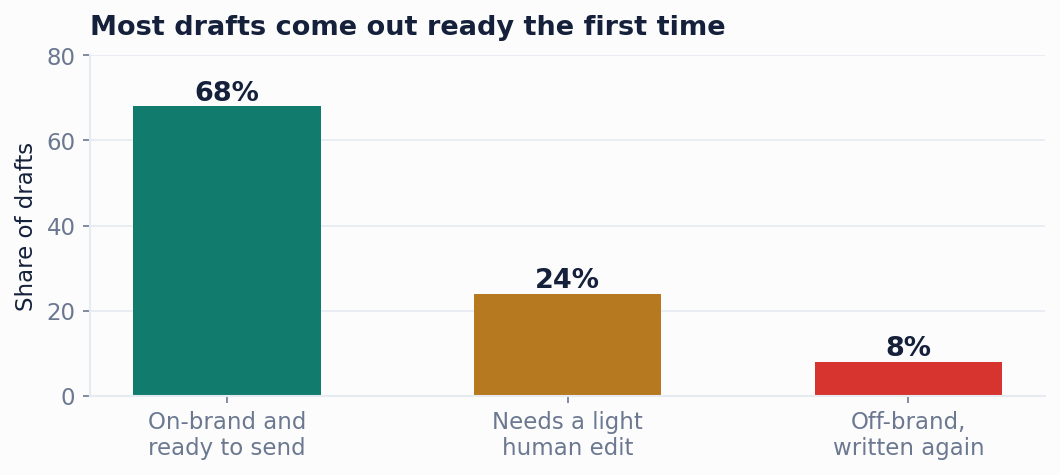
Before a single human reads it, the draft passes through a gate. An automated check looks at three things. Does it sound like your brand. Does it keep to your rules, such as no promises you cannot deliver and any required disclaimers present. Does the pricing match the approved list. Based on that, the draft is sorted into one of three lanes: ready to go, needs a small human edit or off-brand enough that it should be written again.
# Check the draft before a human ever sees it
report = brand_and_compliance_check(draft)   # tone, claims, disclaimers, price match

if report.on_brand and report.compliant:
    route = "ready"          # a human does the final read, then sends
elif report.fixable:
    route = "needs_edits"    # small human edits
else:
    route = "regenerate"     # off-brand, write it again
Here is the kind of note the gate produces. It is written for the salesperson, so they can see at a glance what to do.
Draft #PR-1042 · Needs edits · brand 0.82
Summary
A first draft for a mid-market client, built from the call summary and two approved case studies. Close to ready, with one policy issue to fix.What the gate flagged
- A 25% discount was written into the pricing, which is above the 15% a rep can offer without sign-off.
- The closing paragraph drifts from the brand voice and reads a little generic.
- Everything else, including the case studies and the timeline, matches approved content.
Recommended edits
Bring the discount back to policy or route it for approval. Tighten the closing paragraph to the brand template. After that it is ready for a final read.Recommended action: send to the rep for a two-minute edit rather than a rewrite. The draft is on-brand and factually correct apart from the discount. Confidence: high.
Step 5: A human sends it and it learns
A ready draft goes to the salesperson for a final read. They make any small changes, add the personal touch that only they can and hit send. Nothing leaves the building without a human choosing to send it.
Two useful things are captured along the way. The edits the person made and whether the deal was eventually won or lost. Both feed back into the system. Over time the drafts land closer to what your best reps would have written and fewer of them need fixing at all. The system quietly gets better at the exact places where it was weak.
The payoff: What it saves
The first thing you get back is time. Almost all of the assembly work disappears, so a finished call turns into a solid draft in minutes.
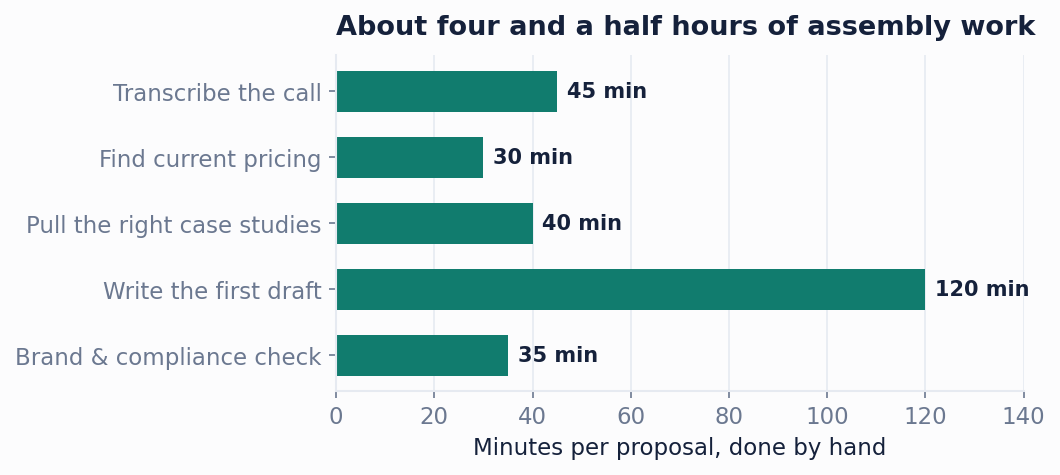
- Hours to minutes: from the end of the call to a first draft in the rep's hands
- Most: drafts come out on-brand and ready for a quick human check
- Same day: proposals go out while the client still remembers the conversation
The second thing you get is consistency. Because every draft passes the same gate, most come out ready the first time, a smaller share needs a light edit and only a few are sent back to be rewritten.
The third thing shows up over the weeks that follow. Because the system learns from every edit and every win or loss, the share of drafts that need fixing keeps falling.
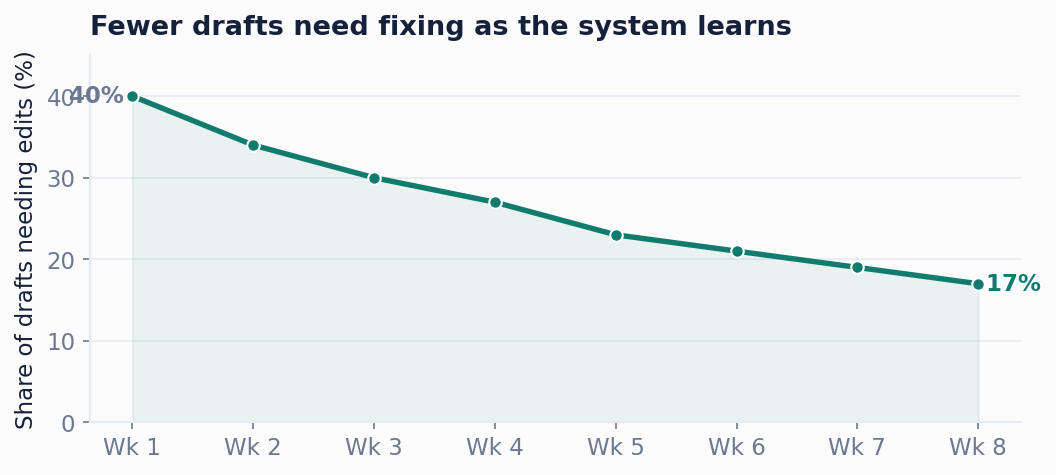
These numbers are illustrative and yours will depend on how well your pricing and case studies are organised to begin with. That is worth saying plainly. The cleaner your approved content, the better the drafts, from day one.
Applied: Where this fits your business
Proposals are just the clearest example. The same pattern fits almost any document that follows from a conversation or a form. Quotes, statements of work, follow-up emails, onboarding packs and account summaries all take a small set of inputs, mix them with approved content and produce a document that a person should sign off on before it goes out.
What it takes to do this well is not exotic. You need your approved content organised and current, a clear brand and compliance gate and a person kept firmly in the loop. That is the work we focus on at Neulaxy: taking a repetitive, high-stakes writing task and turning it into a fast, reliable draft that your team can trust and stand behind.
The takeaway: Wrapping it up
The agent is not there to replace your salespeople. It is there to give them back the two hours after every call that used to go into copy and paste. The relationship, the judgement and the final send stay with the person, where they belong. The draft simply shows up on time, on-brand and built from facts you approved.
If there is one idea to carry away, it is this. Do not automate the sales call. Automate everything tedious that happens after it and let your people spend their time where they are worth the most.
Facing a similar challenge?
Let's talk about how applied AI can move the needle for your business.

Founder and CEO of Neulaxy, with over two decades building large-scale, security-critical technology across banking, telecom, education and healthcare. Now focused on practical, secure, production-grade AI.
More about Neulaxy →Generative & Agentic AI
Copilots, RAG knowledge assistants, autonomous agents and voice, grounded in your data.
Explore Generative & Agentic AI