


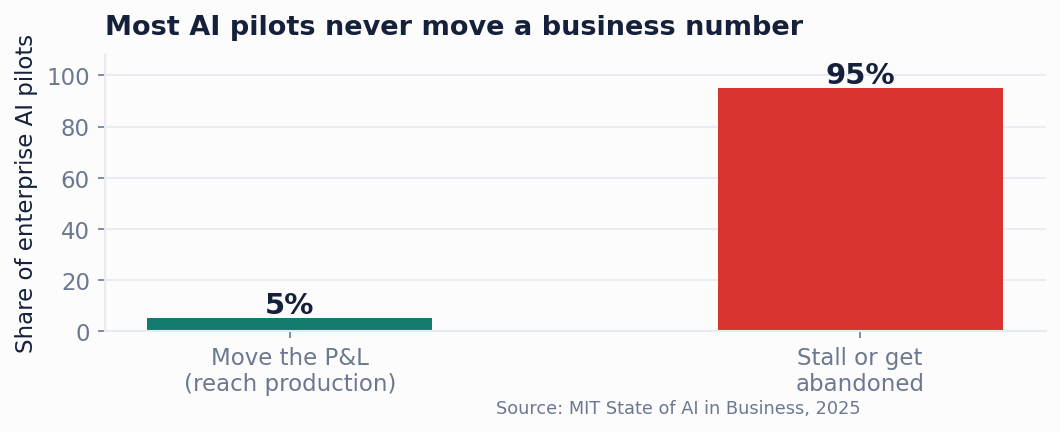
The uncomfortable place to start is with the number. In 2025 MIT studied the state of AI in business and found that ninety-five percent of enterprise generative AI pilots delivered no measurable impact on the bottom line. Not ninety-five percent of ideas. Ninety-five percent of pilots that companies actually funded and ran.
When a failure rate is that high across that many companies, the problem is not bad luck and it is not a shortage of clever models. Something structural is going wrong on the way from a promising demo to a system the business relies on. This article is about what that something is and about the path that avoids it.
The problem: Where AI projects go to die
Picture the journey as a piece of ground with a chasm across the middle. On the near side sit the easy, exciting parts: the ambition and the pilot. A small team builds a demo, it works on a few examples and everyone is encouraged. On the far side sits production, where the system runs every day on real data for real users. Between the two is a gap and most projects fall straight into it.
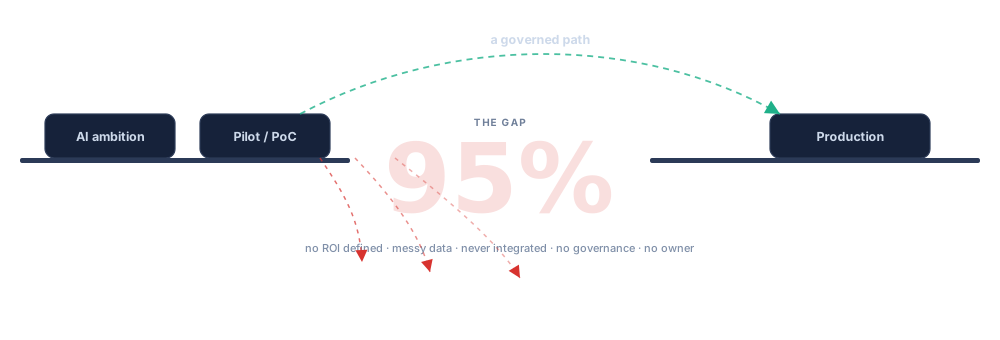
The falls are not mysterious. Look closely and the same five reasons show up again and again. No one defined what success in money terms would look like before the build started, so the pilot had nothing to prove. The data turned out to be messier than anyone admitted, so the model that shone on a clean sample fell apart on the real thing. The pilot was never wired into the systems people actually use, so it stayed a toy. Nobody thought about governance, so legal and risk blocked it at the last moment. And no team inside the company owned it, so when the original builders moved on, it quietly died.
The pattern behind the number. MIT and others point at the same culprits: data that was not ready, work that was never integrated into a real process and no clear outcome agreed before anyone started building. Gartner expects roughly thirty percent of generative AI projects to be dropped after the proof of concept and a majority of AI projects to stall through 2026 for lack of AI-ready data. These are not model failures. They are path failures.
The reframe: A path problem, not a model problem
Once you see the five reasons, the fix becomes obvious. You do not need a bigger model. You need a path that refuses to let a project move forward until the thing that usually kills it has been dealt with. That is what a governed path is. It is the ordinary sequence of steps, with two checkpoints placed exactly where projects tend to fall.
It also helps to be honest about who should build it. The same research found that AI brought in through experienced partners reaches production far more often than the average internal first attempt. That is not a knock on internal teams. It is a reflection of how many small, unglamorous decisions sit between a demo and a dependable system and how much it helps to have walked the path before.
The path: From an idea to a system you can trust
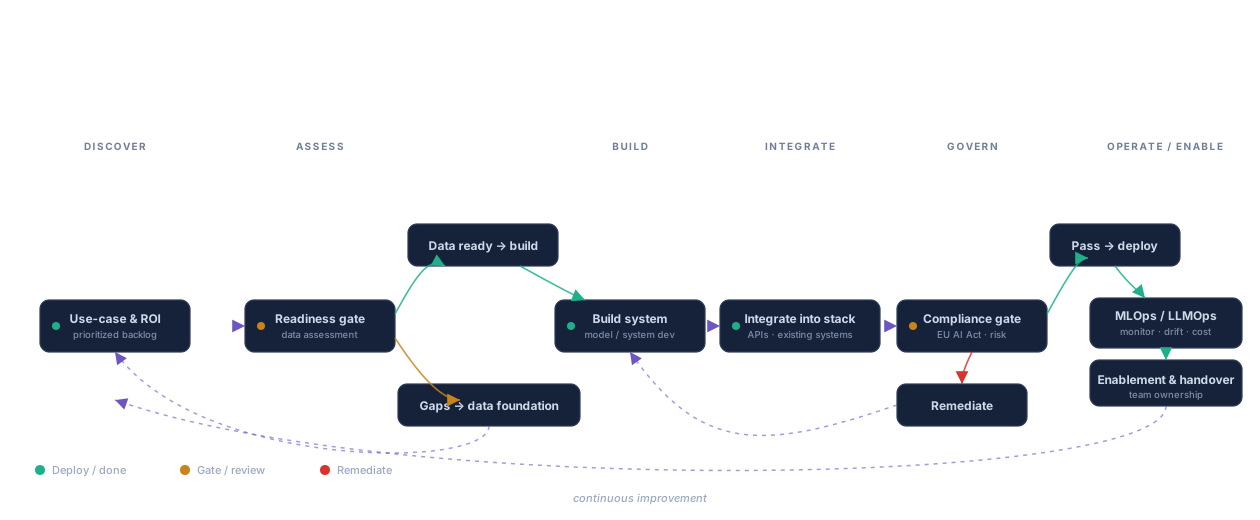
Here is the whole path on one line. You discover the highest-value use case, you check readiness before you build, you build the system, you integrate it into your stack, you pass it through a governance check and then you operate it and hand ownership to your team. The two amber boxes are the gates and they are where most of the value hides.
The core idea: Two gates do most of the work
If you take one thing from the diagram, make it the two amber boxes. A gate is a simple rule: the project may not pass until a specific question is answered honestly. Two gates, placed well, prevent most of the falls we just described.
The first is the readiness gate, right after you pick a use case and before you build anything. It asks a blunt question: is the data actually good enough for this to work. If yes, you build. If not, the honest move is to stop and fix the data foundation first, rather than build on sand and discover the problem in production. This one gate removes the two most common causes of failure, weak data and no agreed outcome, before a line of model code is written.
The second is the compliance gate, right before you deploy. It asks whether the system meets your risk and regulatory bar, including the EU AI Act where it applies. If it passes, it ships. If not, it goes back for a specific fix rather than being quietly launched and hoping nobody notices. This is the gate that keeps legal and risk from killing the project at the last minute, because they were part of it from the start.
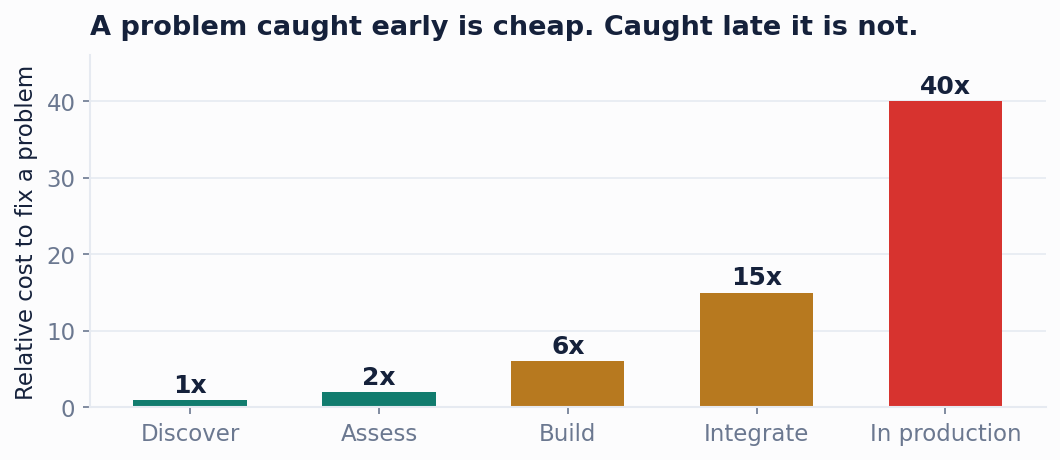
The reason gates matter so much is arithmetic. A problem found at the readiness stage is cheap to fix. The same problem found in production is expensive and it arrives with unhappy users attached.
Side by side: The ungoverned path and the governed one
The steps are almost the same in both cases. The difference is the two questions you are forced to answer and when.
| Ungoverned | Governed |
|---|---|
| Build first, define success later | Agree the ROI before building |
| Assume the data is fine | Pass a readiness gate on the data |
| Bolt on integration at the end | Integrate into the real stack as you build |
| Meet legal and risk the week before launch | Pass a compliance gate before deploy |
| Original builders keep the keys | Hand ownership to your team |
| Stalls in the gap | Reaches production and stays there |
The graph earlier in the piece is the whole argument in one image. Most pilots land in the red bar. The point of the two gates is to move your project into the small green one and to do it on purpose rather than by luck.
The payoff: What you actually get
When the path is followed, three things change and they map directly to what a business cares about.
- De-risked before you invest: The readiness gate kills weak bets early, so money goes to the AI that will actually pay back.
- Roadmap to production: A clear path with checkpoints, so an idea becomes a running system instead of a stalled pilot.
- Your team owns it: Enablement and handover mean the system keeps running long after the build is done.
None of this is about being cautious for its own sake. It is about spending your AI budget on the projects that reach production and protecting them once they get there. The point of governance is not to slow AI down. It is to make sure the AI you ship is AI you can keep.
The takeaway: Where to start
You do not fix a ninety-five percent failure rate with a better model. You fix it by refusing to skip the two questions that projects always skip. Before you build, prove the data is ready and the outcome is worth it. Before you ship, prove it meets your risk bar. Then hand it to a team that will own it.
If there is one idea to carry away, it is this. Treat production as the goal from the first day, not as a surprise at the end. The companies in the successful five percent are rarely the ones with the cleverest model. They are the ones that walked a governed path.
Facing a similar challenge?
Let's talk about how applied AI can move the needle for your business.

Founder and CEO of Neulaxy, with over two decades building large-scale, security-critical technology across banking, telecom, education and healthcare. Now focused on practical, secure, production-grade AI.
More about Neulaxy →AI Strategy & Consulting
Readiness, roadmap, MLOps and integration that de-risk enterprise AI from idea to production.
Explore AI Strategy