


If you have ever found yourself staring at a long list of algorithms, wondering whether to go with Random Forest, XGBoost, SVM, or a Neural Network, you are not alone. With how fast AI is evolving, it's tough to keep up with all the latest models, and more often than not we end up choosing the ones we are most familiar with, even when they may not be the best fit for the problem at hand.
While there is no silver bullet for model selection, and the sheer number of hyperparameters can make the process feel overwhelming, this post offers a few practical guidelines to help you make more informed choices. We will also walk through two real-world code examples to see how model selection varies based on different parameters. Just a heads-up: I'm assuming you are already a little familiar with machine-learning models, so we can dive straight into the good stuff.
1. Know your ML problem
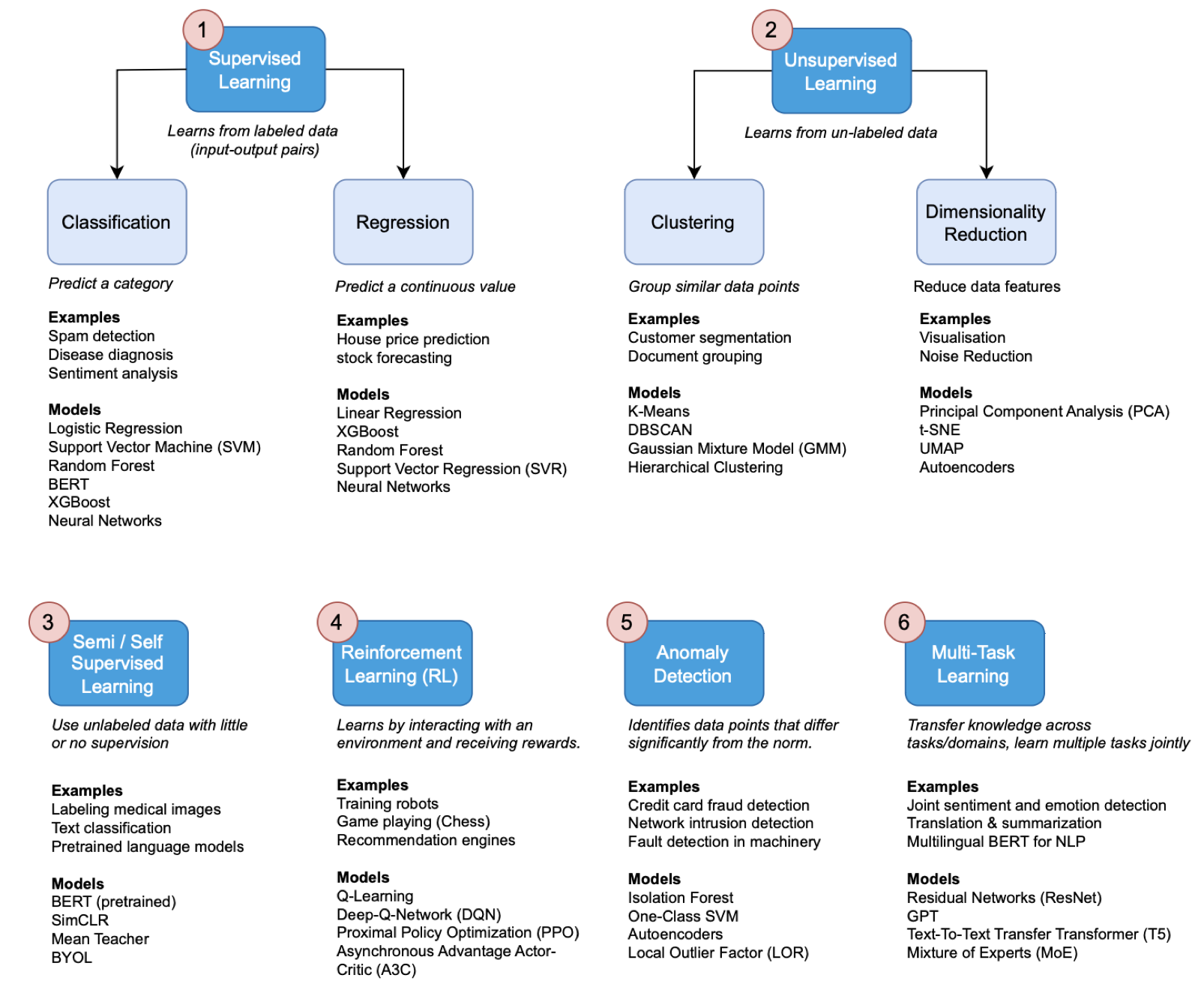
Start by understanding what kind of problem you are solving: classification, regression, clustering, or something else entirely. ML problems are broadly categorised based on the type of data and the desired output. Here are the main types of ML problems with examples:
2. Size of dataset
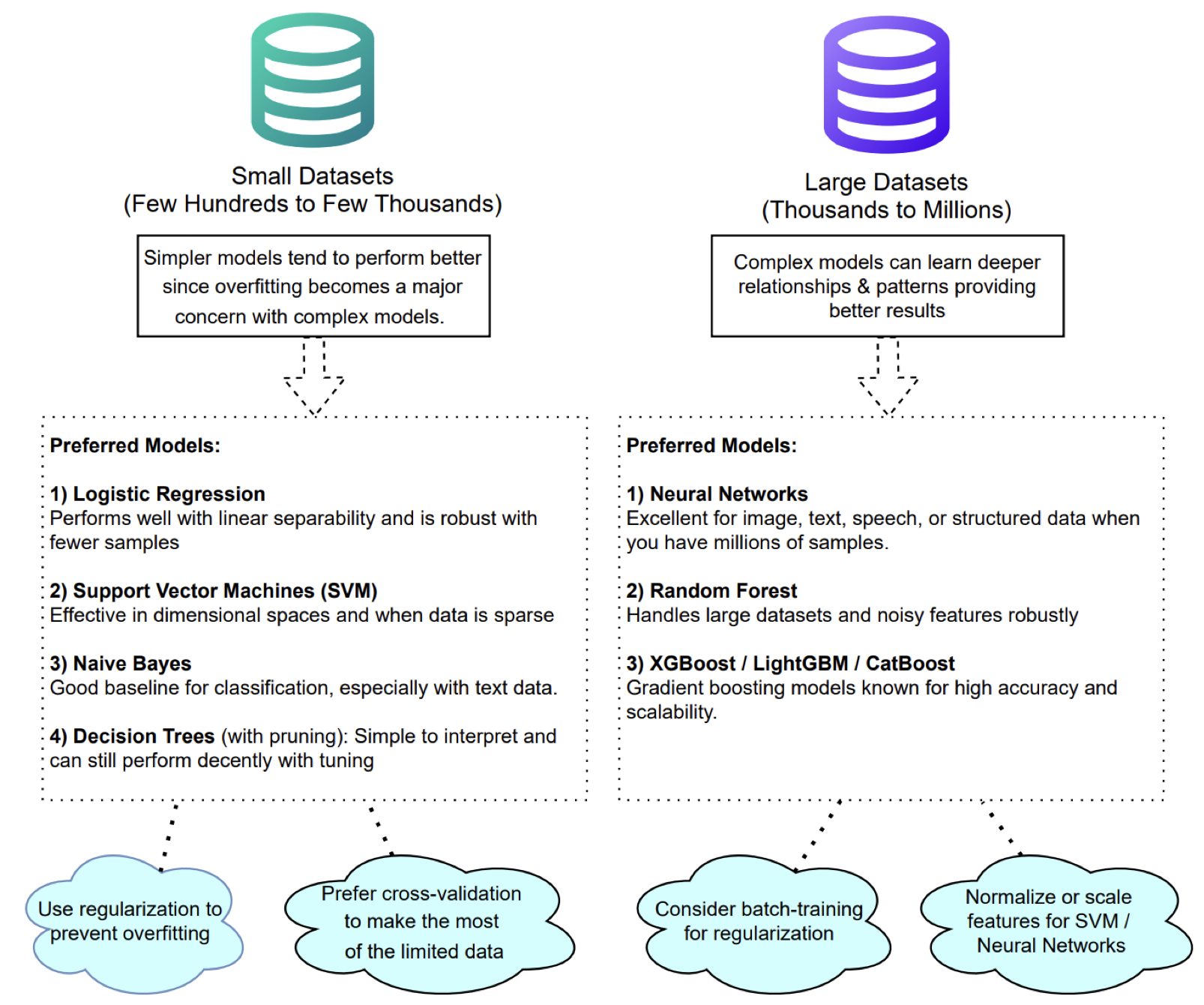
The size of the dataset has a direct impact on how well different models can learn patterns and generalize. Some models are data-hungry, while others work surprisingly well with limited examples. Here is a representation:
3. Structure of dataset
Understanding the data's structure is just as important as knowing its size. Certain models are more tolerant to noise, handle sparse or high-dimensional data better, or are built for class imbalance. Let's break it down by feature characteristics.
3.1 High-dimensional data (more features than samples)
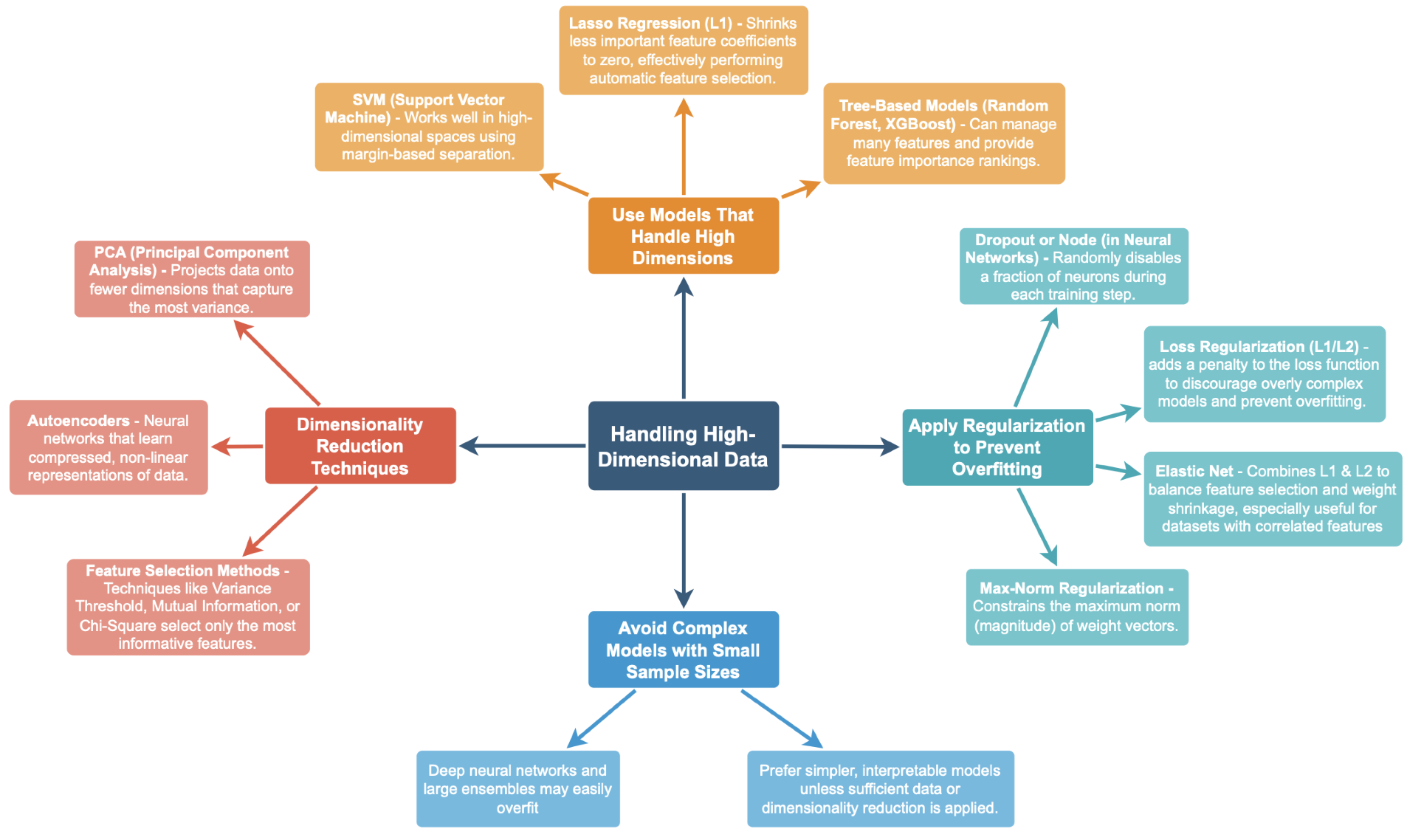
High-dimensional datasets are those where the number of features far exceeds the number of samples, a common scenario in genomics studies such as gene-expression profiling or DNA analysis, where thousands of genes (features) are measured from only dozens or hundreds of patients (samples). While such datasets are rich in information, they introduce a challenge known as the curse of dimensionality. As dimensionality increases, models tend to overfit by learning patterns in the noise rather than capturing meaningful signal, which often leads to poor generalization on unseen data.
To handle this effectively, it's important to either use models that are robust in high-dimensional spaces or apply dimensionality-reduction techniques before modeling. Here are a few strategies to handle high-dimensional data:
3.2 Imbalanced classes
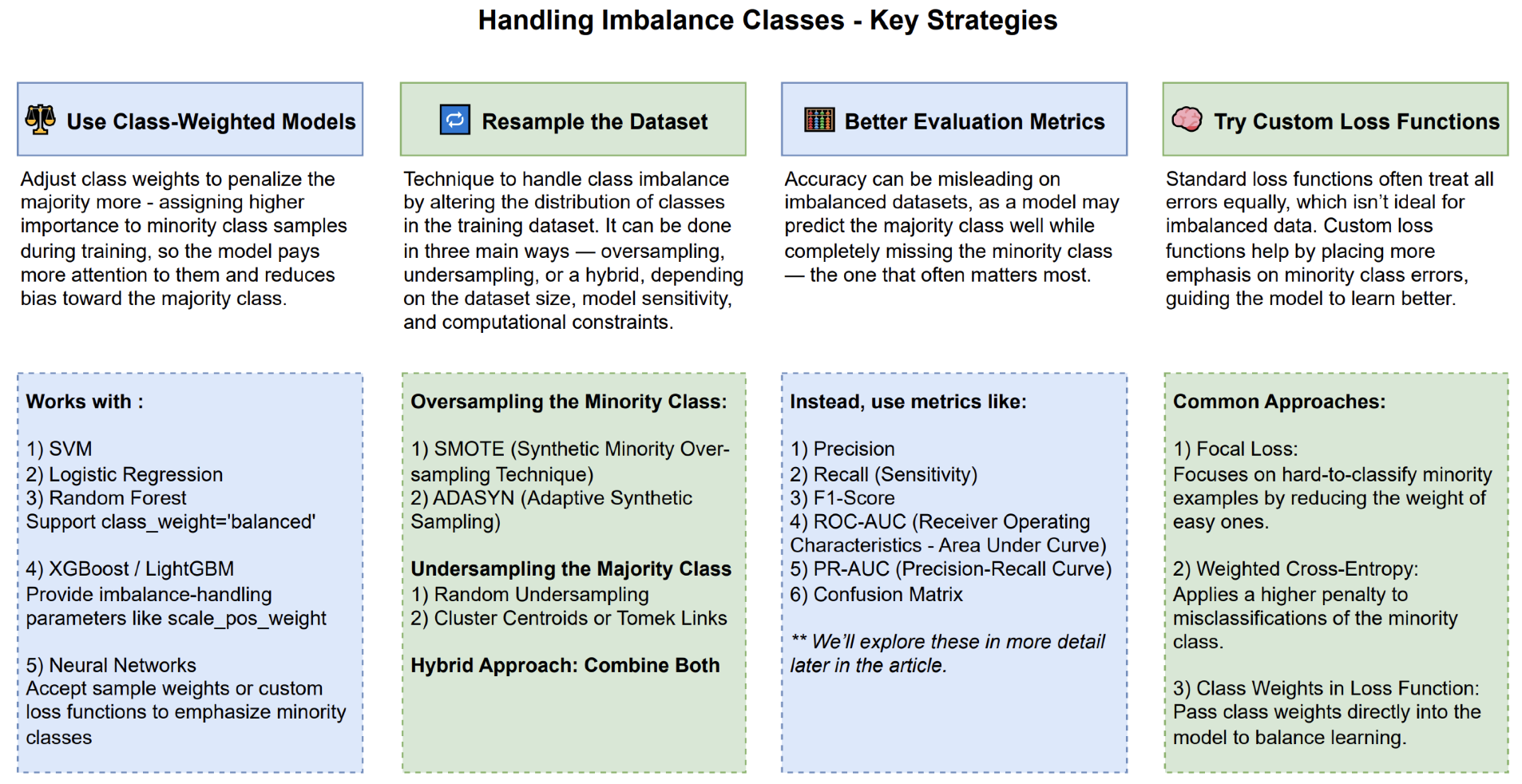
Many ML problems involve rare events (such as fraud detection, medical diagnosis, or customer churn) where one class significantly outnumbers the other. For example, in a medical dataset 95% of patients may be healthy while only 5% have a particular disease. In such cases a model might achieve 95% accuracy simply by always predicting the majority class, but that would completely miss the minority class, which is often the most critical to detect.
This can become a serious issue, as models often learn the bias present in the data distribution, leaving important minority cases ignored or underrepresented during training. Traditional metrics like accuracy can also be misleading, giving a false sense of model performance.
3.3 Noisy or missing data
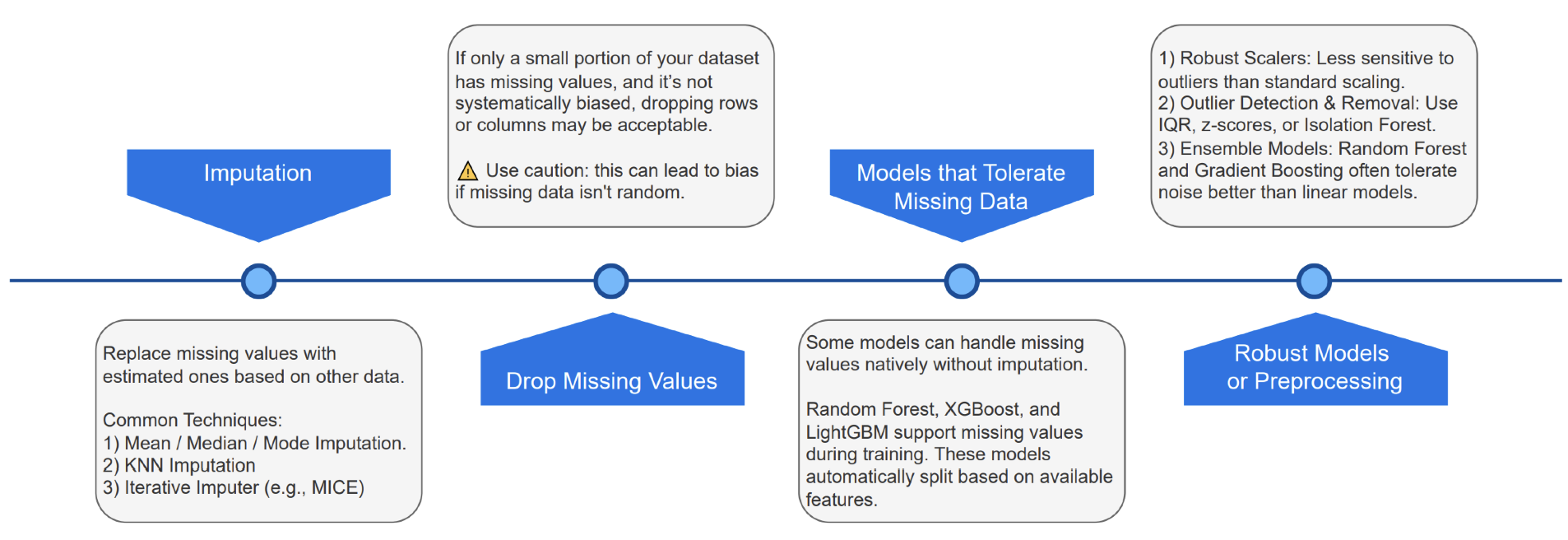
Even the best machine-learning model can fail if the data it's trained on is incomplete or full of noise. In real-world scenarios, whether you're working with medical records, IoT sensors, or scraped text, it's common to encounter missing values, inconsistent entries, or random noise.
This kind of messy data doesn't just affect performance, it can completely change which models are suitable for your problem. Here are a few strategies to handle it effectively:
3.4 Sparse features
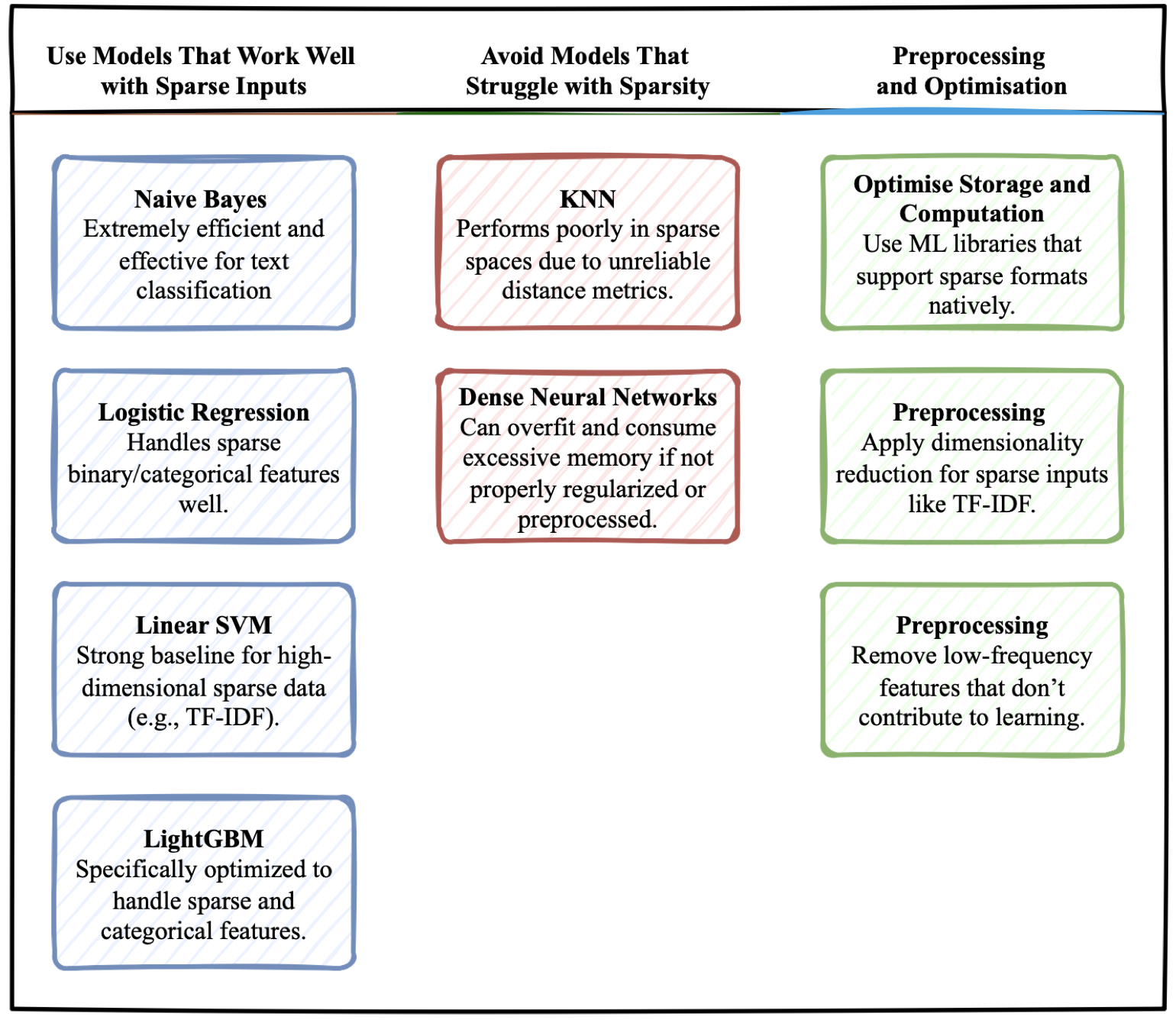
In many machine-learning problems, especially in fields like genomics, NLP, or recommender systems, the input data can be sparse, meaning most feature values are zero or empty. For example, in genomics, mutation presence/absence matrices are typically binary and highly sparse. In a study classifying cancer types, the dataset might contain 15,000 genes (features) across 1,000 patients (samples). Since most mutations are rare, any given patient may only have mutations in 50 to 100 genes, resulting in extreme sparsity.
While sparse datasets aren't inherently problematic, they require models and data structures optimized to handle them efficiently. Choosing a model not suited for sparse inputs can lead to slow training, high memory usage, or weak generalization. Let's look at some strategies to handle sparse data effectively and choose the right model:
4. Feature types
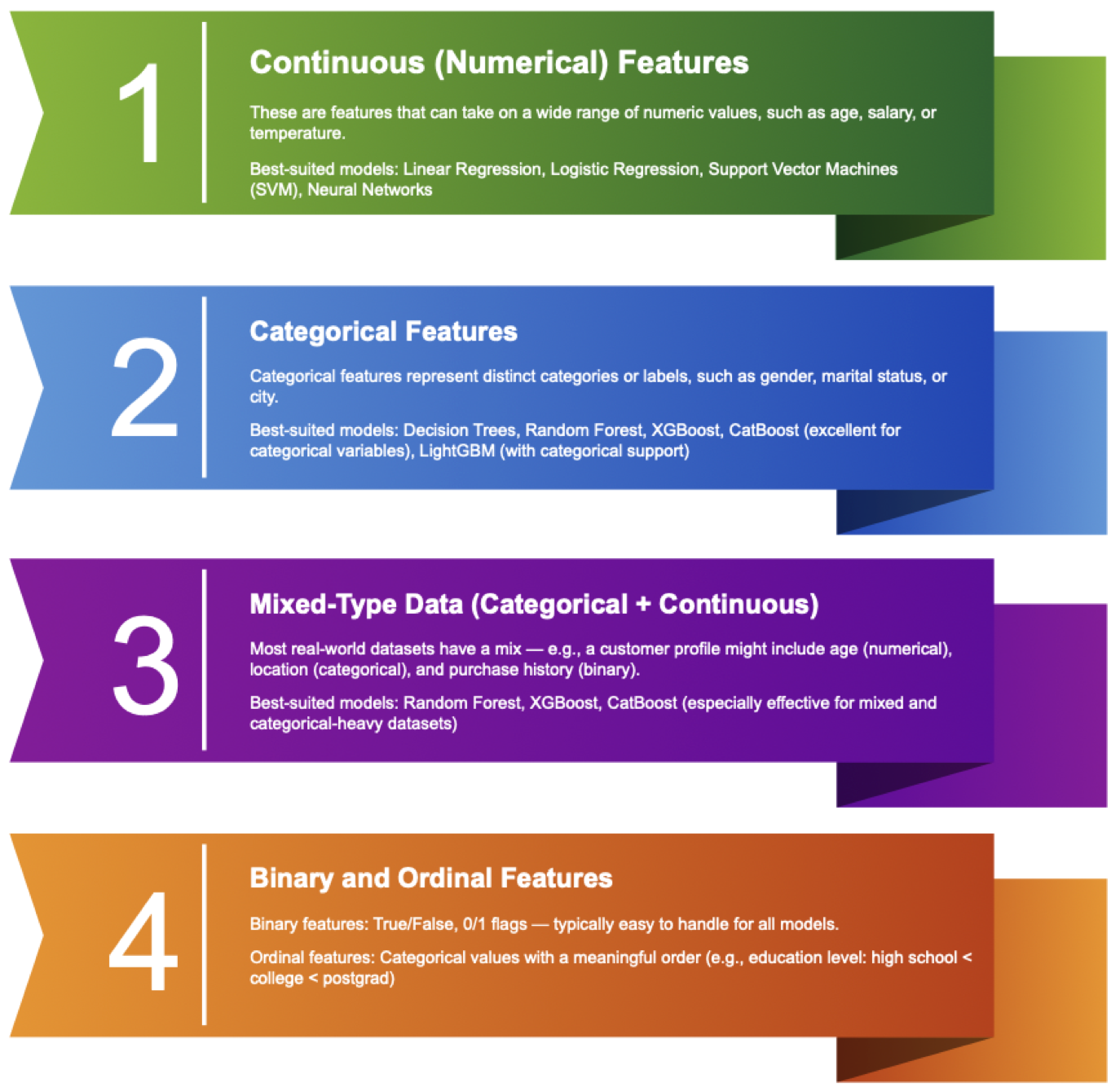
Once you have defined your machine-learning task (like classification or regression) and examined the size and structure of your dataset, the next key consideration is the type of features it contains, focusing on the individual characteristics of each column. Different algorithms are better suited to different feature types, and selecting the right one can significantly improve both model performance and training efficiency.
5. Training time and resources
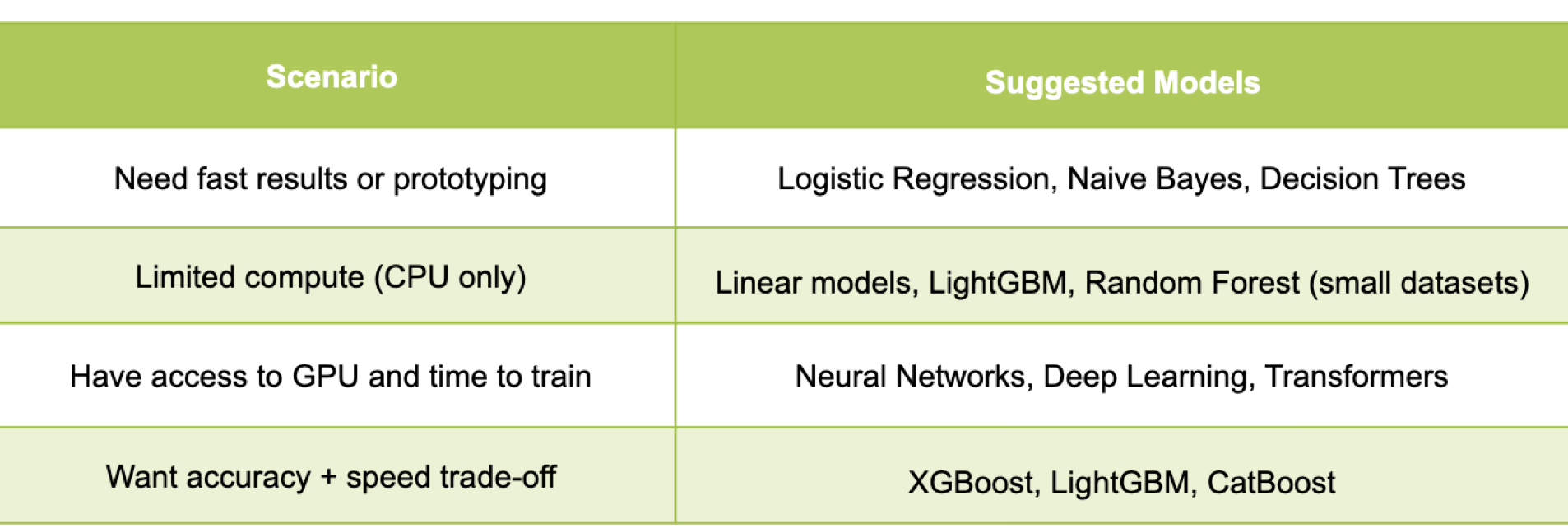
When choosing a machine-learning model, it's important to consider how much time and computing power you have available, especially if you're working under deadlines and with limited hardware.
Some models are fast and lightweight, making them ideal for rapid experimentation or deployment on resource-crunched systems. Others may require extensive training time, specialized hardware (like GPUs), or careful tuning to reach their full potential.
Tip. Start simple, validate quickly, and scale up only if your data and resources justify it.
6. Accuracy vs. generalisation
When evaluating models, it's tempting to chase the highest possible training accuracy, but that can be misleading. What truly matters is how well your model performs on unseen data, and that's where generalization becomes crucial.
A model that performs exceptionally well on the training set may just be memorizing patterns (a classic case of overfitting) rather than learning the true structure of the data. In contrast, a model that generalizes well captures meaningful trends and consistently performs on new, unseen inputs. A few strategies to improve generalization:
- Use cross-validation to evaluate performance across different subsets of data early on.
- Start with simpler models when your dataset is small or contains noise.
- Apply regularization techniques (L1, L2, etc.) to prevent overfitting.
- Monitor validation loss or test accuracy, not just how well the model performs on training data.
7. Model evaluation needs
Since we train models to solve real-world problems, it's important to clearly define what success looks like. The way you evaluate your model's performance should guide your choice of algorithm. Different problems need different evaluation strategies: some require probability scores, while others focus on precision, recall, or ranking quality. That's why it's crucial to think about how you'll measure performance before you choose or train a model.
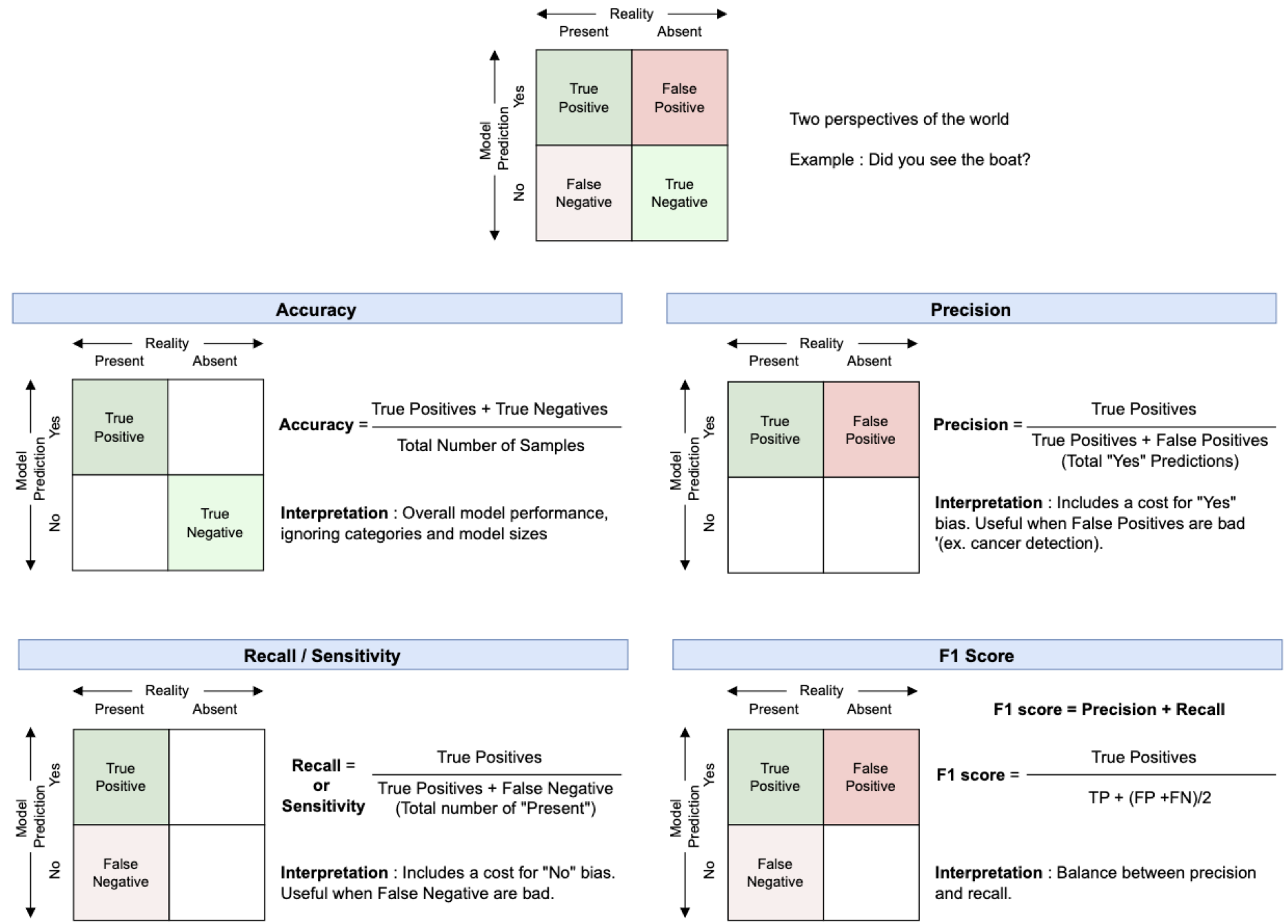
Rather than covering every evaluation metric out there, we'll focus on four commonly used in binary classification, the same ones we'll apply in our test examples below.
Putting it together with two examples
While we've covered a lot so far, this is still just scratching the surface, there are many more factors that can influence model selection. As you may have noticed, much of the focus has been on understanding the data itself, and for good reason: a deep understanding of your data gets you more than halfway toward choosing, training, and testing the right model. In this section we'll examine how variations in input data affect model performance and selection. To keep things simple, we'll use basic binary-classification examples.
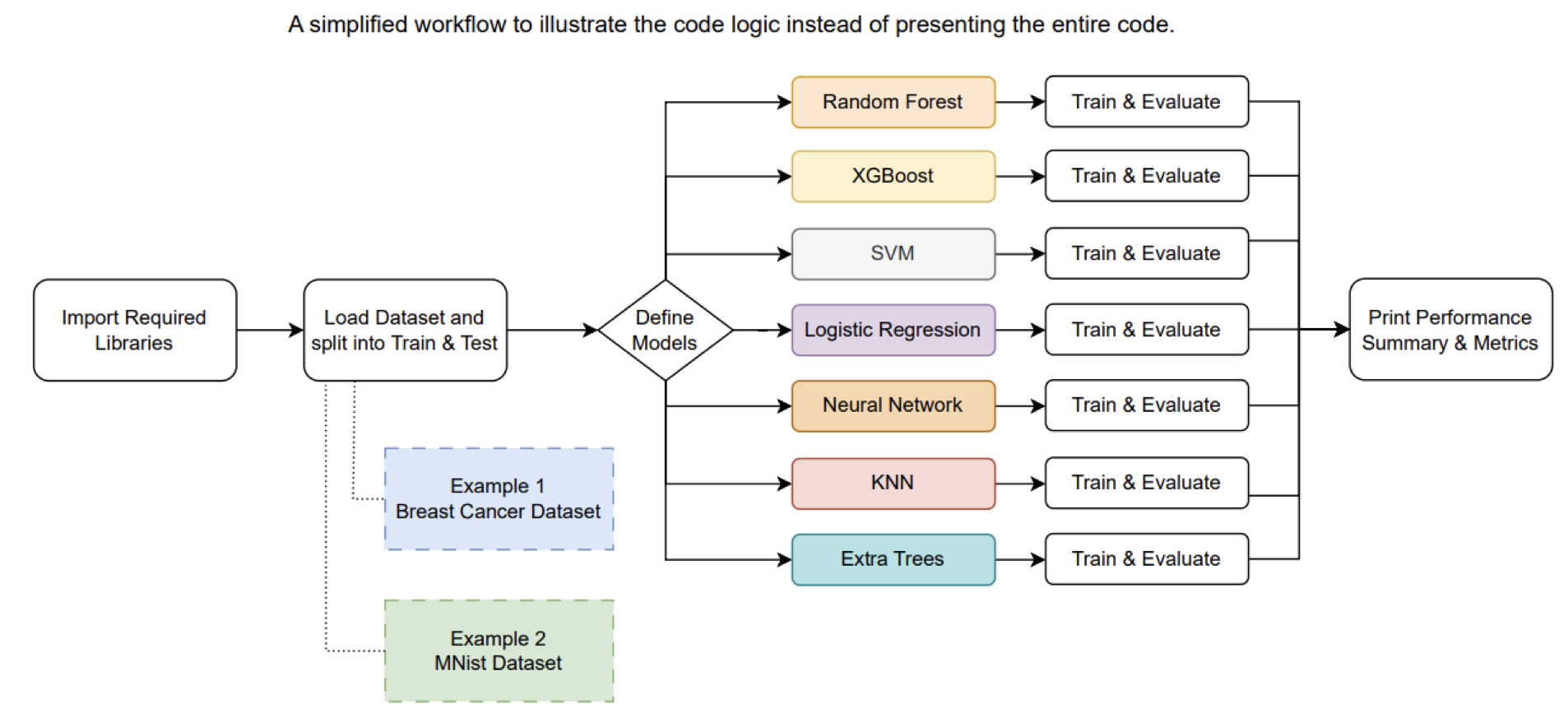
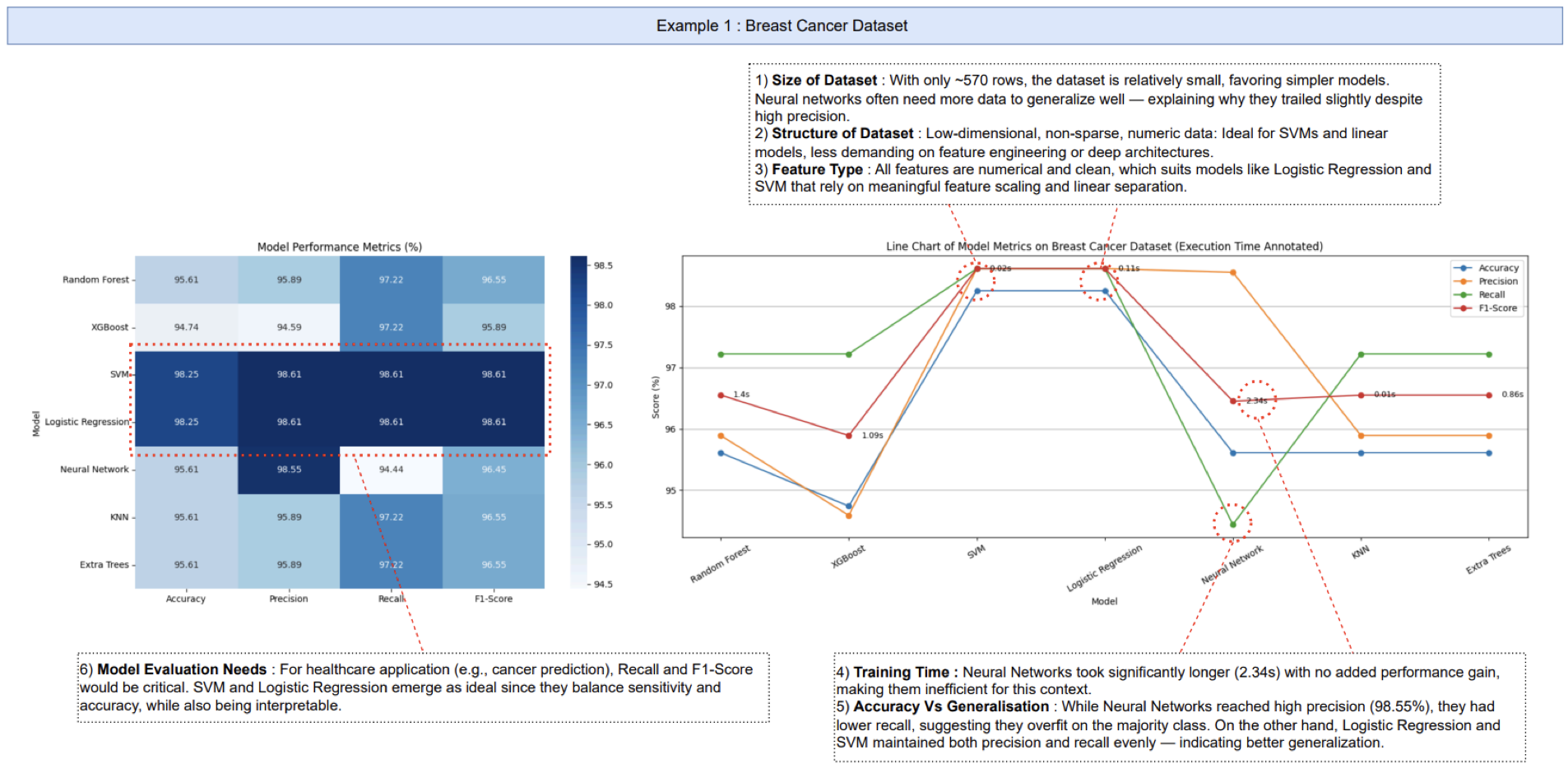
Here the same set of models is trained and evaluated on two very different datasets. Example 1 uses the Breast Cancer dataset, small (~570 rows), low-dimensional and clean, which favours simpler models like SVM and Logistic Regression.
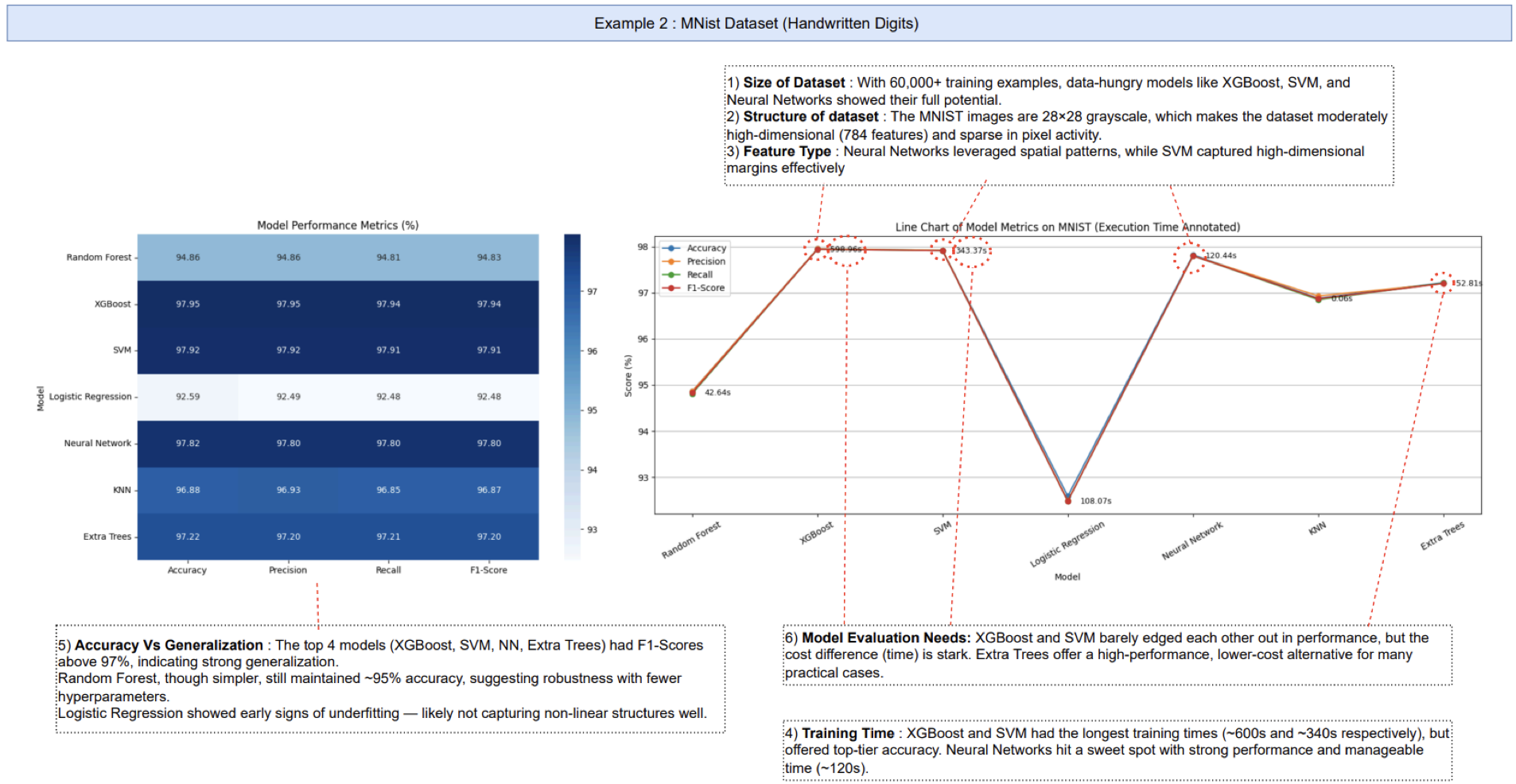
Example 2 uses the MNIST dataset, large (60,000+ examples), moderately high-dimensional and sparse, where data-hungry models like XGBoost, SVM and Neural Networks show their full potential, and training cost becomes a real trade-off.
Note. All images in this article were created by the author. If you'd like to reuse them, a simple mention is appreciated.
Wrapping it up
Choosing the right machine-learning model isn't just about algorithms and metrics; it's about understanding your data, your goals, and the practical trade-offs involved. Hopefully these tips help simplify that decision-making process.
Coming up next: how building a custom neural network gives you greater control over hyperparameters and architecture than plug-and-play libraries, opening the door to deeper experimentation and hands-on learning.
Facing a similar challenge?
Let's talk about how applied AI can move the needle for your business.

Founder and CEO of Neulaxy, with over two decades building large-scale, security-critical technology across banking, telecom, education and healthcare. Now focused on practical, secure, production-grade AI.
More about Neulaxy →Machine Learning & Predictive AI
Custom ML and predictive models: forecasting, computer vision, and anomaly and fraud detection on your data.
Explore Machine Learning