

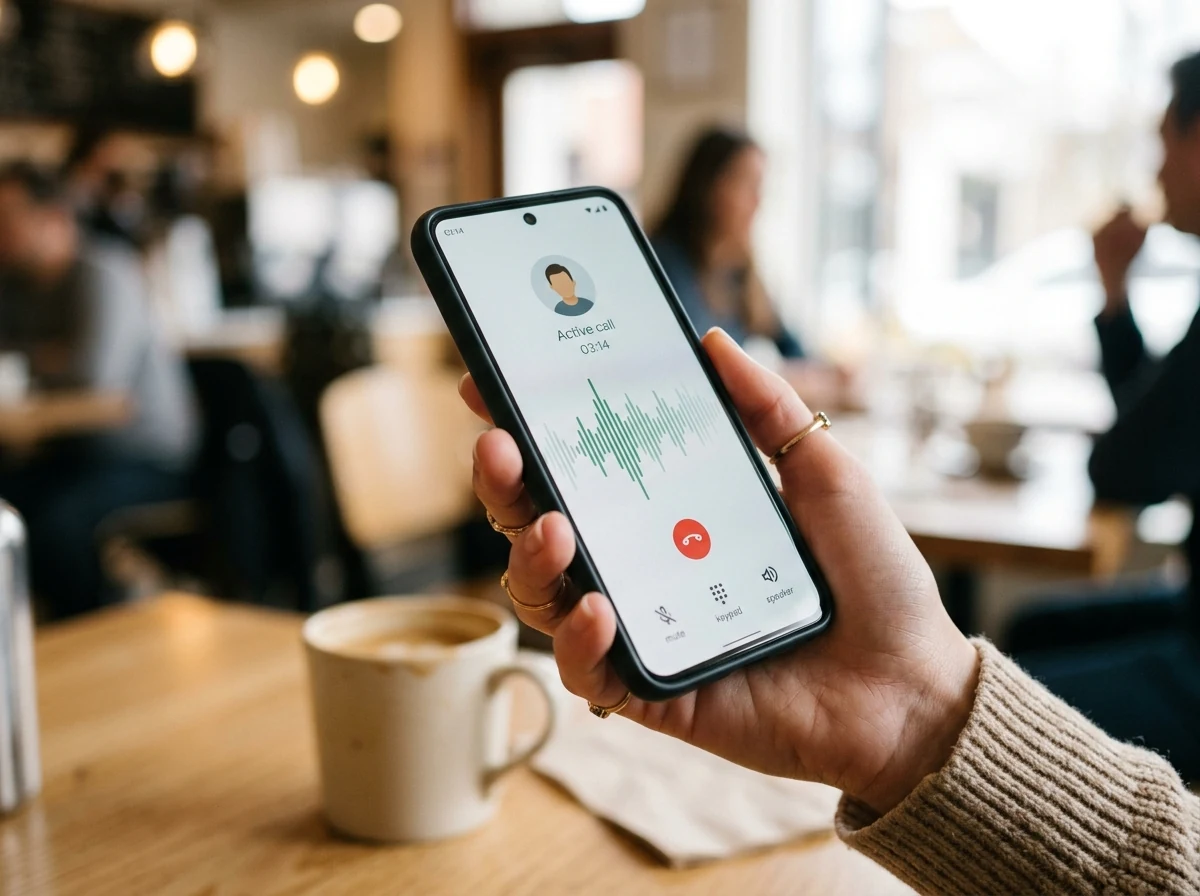
A caller will forgive a lot. They will forgive an accent, a bit of formality, even the occasional "let me check that for you." The one thing they will not forgive is the pause. The silence after they stop speaking, while the machine thinks, is the exact moment a call stops feeling like a conversation and starts feeling like a form.
That pause is why most phone bots are unpleasant. They speak in a flat voice, they fall apart the moment you interrupt them and they cannot actually answer your question, so they push you toward a menu or a website. Building a voice agent people are happy to talk to is really one engineering problem worn many ways. You are racing a clock and the clock is short.
The problem: The silence is what feels robotic
Human conversation has a rhythm. When one person stops, the other starts within roughly a second. Go much beyond that and the silence becomes loud. The listener wonders if the line dropped or starts talking again just as the other side does. Old voice bots blow through that window every single turn, because they wait for you to finish, then send the whole recording off to be transcribed, then wait for a full answer, then read it out. By the time they speak, the moment has passed.
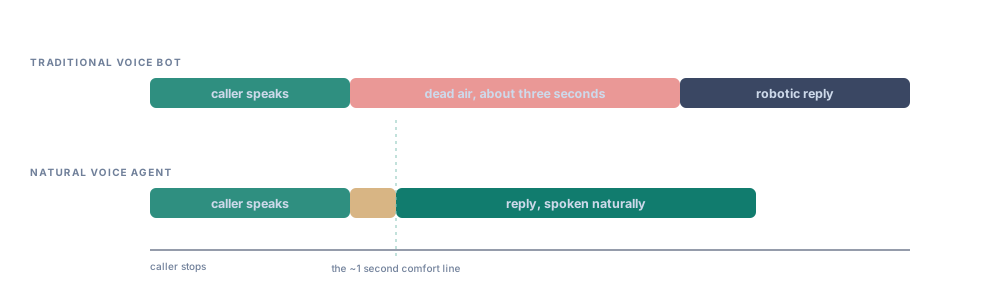
The natural agent in the lower row does the same job but it never lets the gap open. It starts transcribing while you are still talking, it begins forming an answer the instant you stop and it starts speaking the first words before the rest of the sentence is even finished. The reply lands inside the comfort window, so the call keeps feeling like a conversation.
The idea: It is a race against a one and a half second clock
Here is the useful way to think about it. From the moment a caller stops talking, you have roughly a second and a half before the silence feels wrong. Everything the agent needs to do has to fit inside that window: notice you have finished, understand what you asked, look up the answer, decide how to say it and turn the first words into audio. That window is a budget and every stage spends part of it.
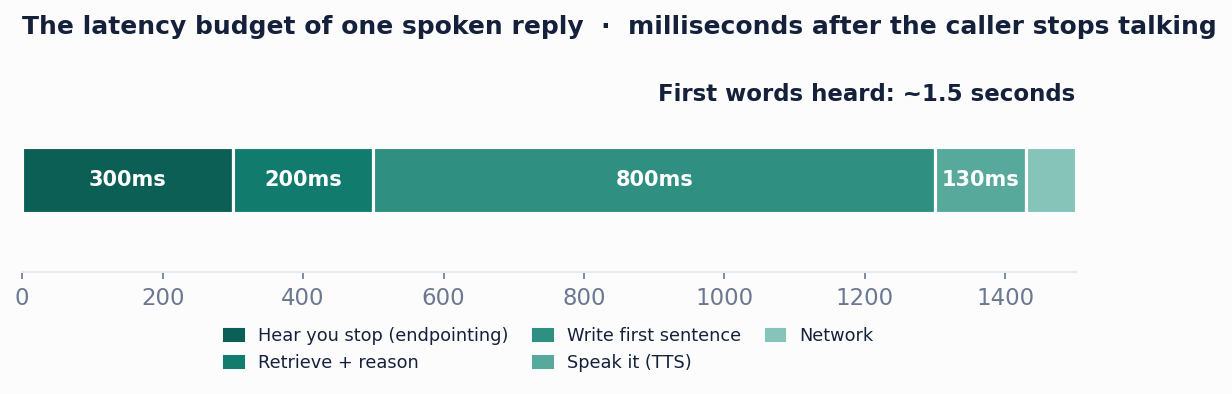
Two things about that budget matter more than any single number. The biggest slice by far is the model writing the first sentence, which is why the trick is to start speaking the moment the first sentence exists rather than waiting for the whole answer. And the stages overlap. The agent is transcribing while you speak and preparing to answer while it transcribes, so the real elapsed time is far less than adding the pieces up.
The blueprint: The whole call on one page
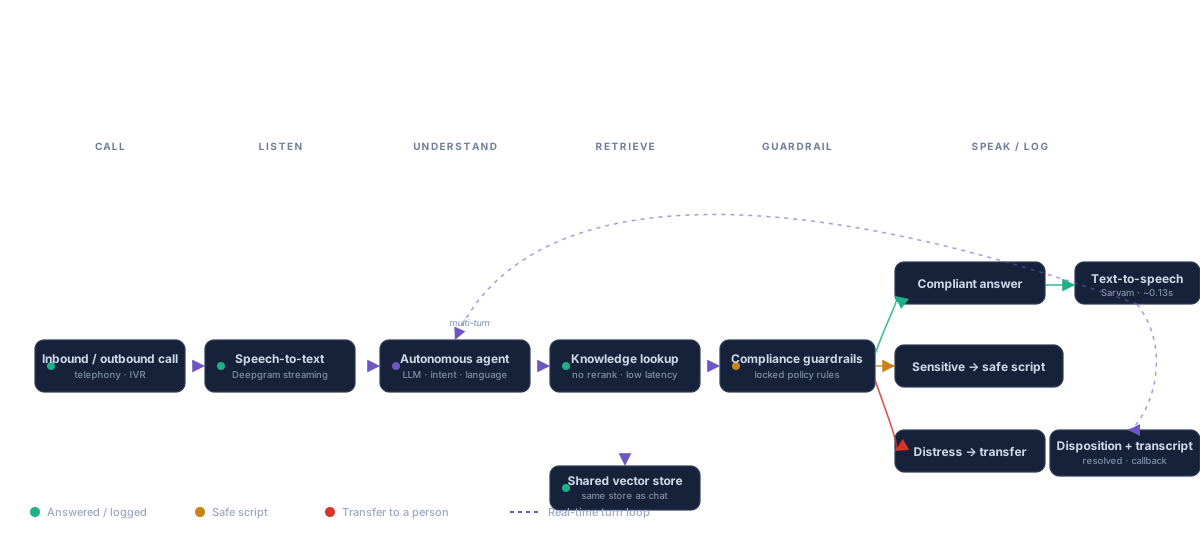
Laid out end to end, the call flows through six stages, with the agent looping through them on every turn until the conversation is done.
The craft: Three things that make it feel human
Underneath the pipeline, three specific choices are what separate a natural agent from a robotic one. None of them is about a smarter model. They are about time and manners.
- Talk before you finish thinking: The agent speaks the first sentence while the model is still writing the rest, so the reply begins almost immediately.
- Let the caller interrupt: If the caller starts talking, the agent stops and listens, the way a person would, instead of plowing through its script.
- Reason over your real knowledge: It looks up answers in the same knowledge base as your chat assistant, so the phone gives the same answers as the website.
The first trick is the one that buys most of the comfort. Instead of holding the whole answer back until it is complete, the agent breaks the reply into sentences and hands each one to the voice as soon as it is ready.
# Do not wait for the whole answer. Start speaking the first sentence.
async for sentence in split_into_sentences(llm_stream(question)):
    audio = tts(sentence)      # low-latency voice (Sarvam / Deepgram)
    play(audio)                # caller hears sentence one while the model writes sentence two
Why the same knowledge base matters If your phone agent and your chat assistant read from different sources, callers get different answers depending on how they reached you and that erodes trust fast. Pointing both at the same knowledge base means one place to update and a caller on the phone hears exactly what a visitor on the website reads. One brain, many channels.
The honest part: Knowing when to hand over
A good voice agent is measured as much by the calls it declines as by the calls it handles. Guardrails keep it on policy, so it will not improvise a price or a promise. When a request falls outside what it should handle or when the caller is upset or in distress, it does not stall or fumble. It hands the call to a person cleanly, with the transcript and context attached, so the caller does not have to start over.
The payoff: What changes for your callers
The headline change is the wait. A traditional line means a menu and then hold music. A voice agent answers on the first ring and starts helping in about a second and a half, at three in the morning as readily as at three in the afternoon.
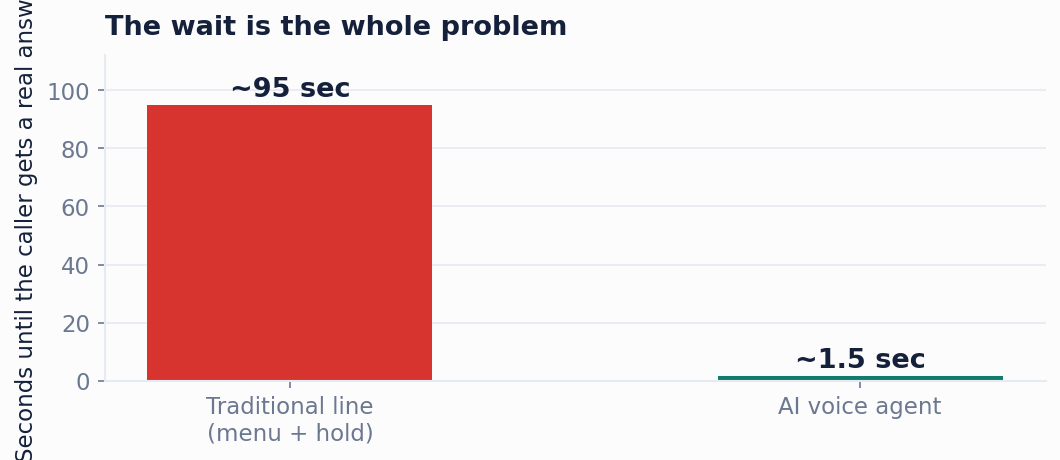
- No hold, ever: Every call is answered immediately, day or night, with no queue and no staffing scramble.
- Real answers, not menus: The agent reasons over your knowledge base, so callers get helped instead of deflected to a website.
- People for the hard calls: Routine calls are handled in seconds and anything sensitive is passed to a person with full context.
Applied: Where this fits
The same agent fits any line that rings more than your team can comfortably answer. First-line customer support, after-hours and overflow calls, appointment booking and reminders order status and simple account questions are all a good match, because they are high in volume and low in ambiguity. And because the agent shares its knowledge with your chat assistant, adding the phone does not mean building a second brain. It means giving the one you already have a voice.
This is the work we focus on at Neulaxy. We build natural, low-latency voice agents that answer on the first ring, reason over your real knowledge, stay on policy and hand the hard calls to your team, so no caller ever waits on hold again.
The takeaway: Wrapping it up
A voice agent does not win because it has the cleverest model. It wins because it respects the rhythm of a conversation. It answers inside the second and a half where a caller is still comfortable, it lets people interrupt, it tells the truth from your own knowledge and it knows when to step aside for a person. Get the timing right and the technology disappears, which is the whole point. The caller just feels heard.
If there is one idea to carry away, it is this. In voice, the answer is only half the job. Answering in time is the other half and it is the half that everyone feels.
Facing a similar challenge?
Let's talk about how applied AI can move the needle for your business.

Founder and CEO of Neulaxy, with over two decades building large-scale, security-critical technology across banking, telecom, education and healthcare. Now focused on practical, secure, production-grade AI.
More about Neulaxy →Generative & Agentic AI
Copilots, RAG knowledge assistants, autonomous agents and voice, grounded in your data.
Explore Generative & Agentic AI